
TOUGH3-EOS7C failed to converge after 10 years
Hello,
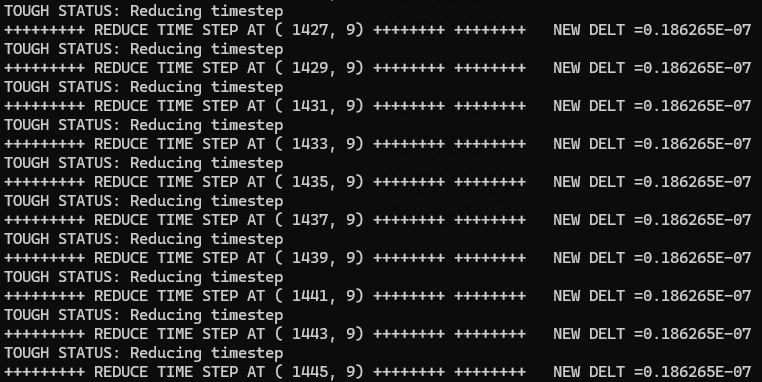
I am simulating an injector and producer doublet in a gas reservoir with TOUGH3-EOS7C. It runs well for the first few years and then struggles to converge with very small time steps (screenshot below).
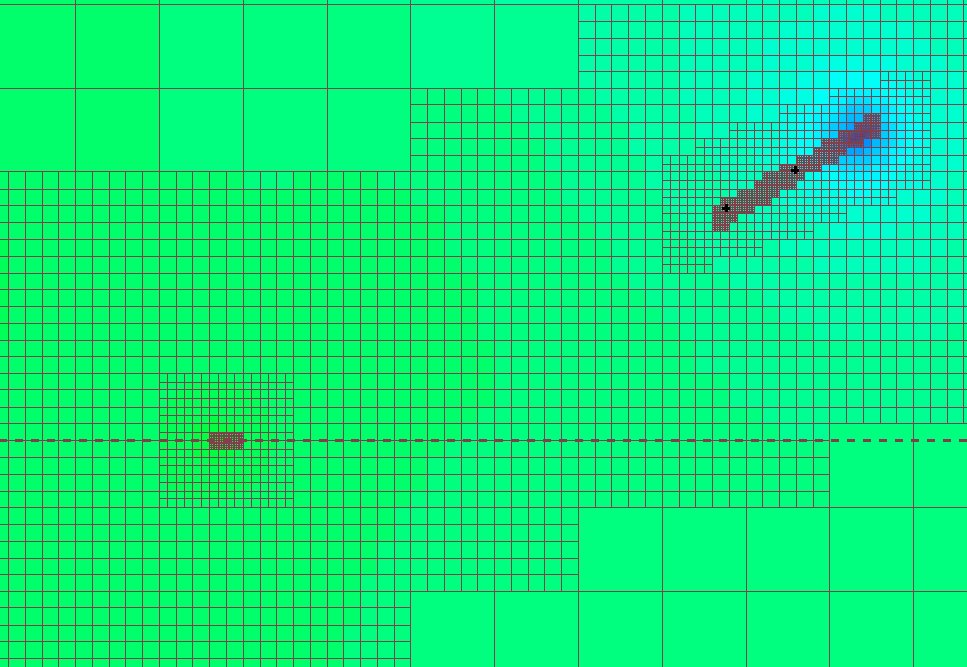
I looked into the OUTPUT file and did not find any error message. The program struggles to converge mainly on two cells (indicated by the black cross in the screenshot below). But the variables at these two locations look good to me. I do have local refinement as small as 1m by 1m surrounding the wells. My injection rate and production rate are both 30 kg/s.
I plotted the pressure change at both injector and producer
Can anyone please point me what could be the problem or what else I need to check? Thank you for any suggestions.
Regards,
Haiyan
4 replies
-
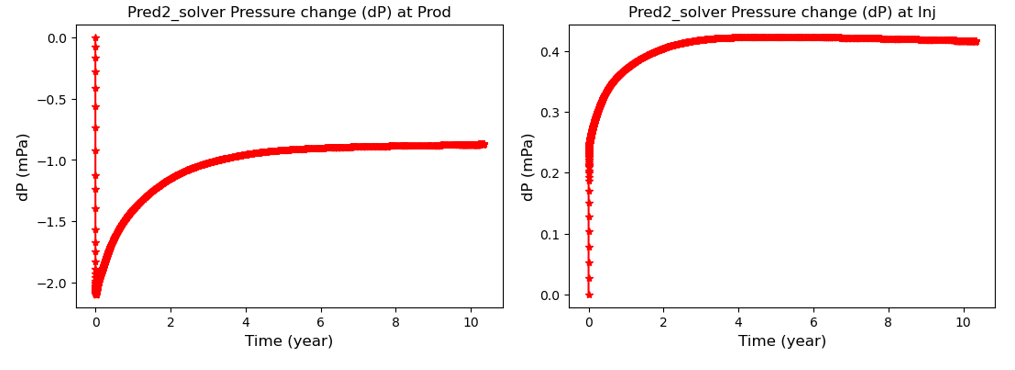
Sorry, the pressure change at the two wells did not show up in the post.
-
From the info provided it is not possible to say why the run essentially stops by reducing the time steps until one step does not converge in 9 iterations, while the subsequent one converges at the first one without changing the primary variables.
You should ask for additional diagnostic printout including: info on iterations to know which element and equation has the highest residual; phase change diagnostic to check if phase transitions are related to problematic elements. In this case check RELP and PCAP curves to see if some of their features are related to the encountered issue. Something like appearance/disapperance of gas phase when using van Genuchten PCAP. Check if EOS7C has any issue in solving the thermodynamic equilibrium of NCGs and water/brine mixture.
You should check if at the injection elements one of the mass component is completely depleted; this may happen if you do not inject all the simulated mass components. You should check if primary variables at production and injection elements are always within allowed ranges.
Additional diagnostic printout should tell you where to look further.
Finally, you are using a spatial grid that does not honor the IFD standard method used by TOUGH2/3 to discretize the balance equations. Not sure if this may have a role on the encountered convergence issues.
Regards,
Alfredo
-
Hi Alfredo,
Thank you for your reply. Here is more information I found in the output.
(1) The 'gas phase disappears/evolves' does exist at some elements (screenshots below) but this happens in the first 10 years too. I do not think this caused the convergence failure.
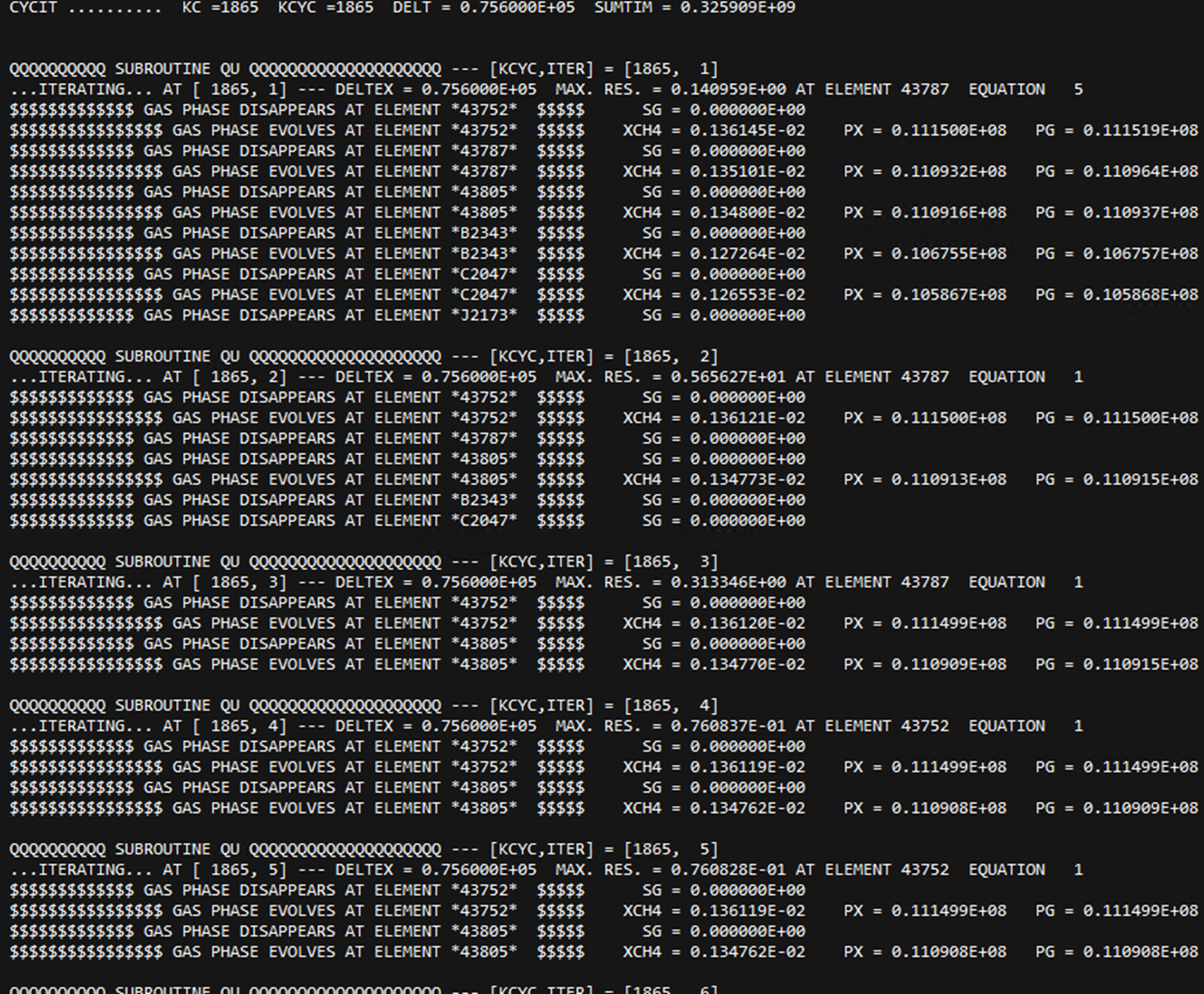
Here is another screenshot of the OUTPUT file.
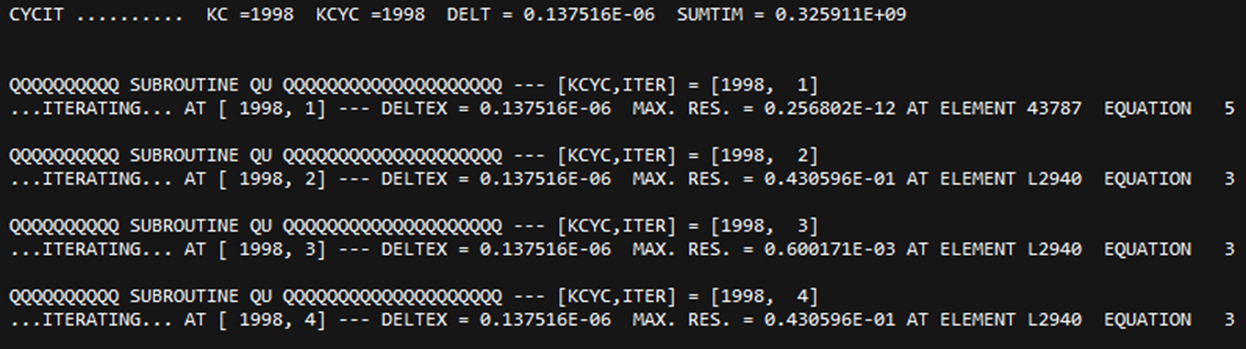
(2) max res. mostly happened to Equations 5, 3 and 1 as shown in the above two screenshots.
I am checking the primary variables and mass components at the injection and production cells. I will add more information once I have it.
By the way, I am injecting 20 °C water through the injection well.
Thanks,
Haiyan
-
Haiyan,
(1) the iterations shows that two elements (43752 and 43805) have a difficult phase transition to two-phase. The bubble P (PG) is only slightly higher than P (PX) after the 3rd iteration, but the gas phase disappears during the subsequent time step. This suggests the L-->L+G phase transitions has issues.
This may be related to the steep change of PCAP in the VG model. Are you using VG curves? You may tray with different PCAP parameters to see if the convergence issue changes.
As an alternative, you may try the Brooks-Corey model (ICP=10) that implements a finite gas entry P and usually avoid the issues related to the very high dPcap/dSL derivative in the VG curve. You can manage to have similar Pcap vs SL values of VG curve, but for the SL-->0 region.
If this does not work, then there could be issues linked to the interpolation of phase density at the interface to be used in the gravitational term of Darcy's equation. The issue is mentioned at pag. 25 of the user's guide. This happens when the phase transition drastically changes the flow of the different phases along the vertical connection. You may monitor both thermodynamic conditions in the two connected elements and the fluxes along the vertical connection to verify if the phase transition actually determines some sharp change of phase flow.
Fixes for the issue have been proposed by John O'Sullivan and coauthors at Auckland University in a series of publications. Such fixes do not seem available in TOUGH3. The final suggested fix is based on a phase saturation weighting scheme to interpolate the phase density at the interface. It can be easily added if the source code is available. Reading of O'Sullivan's papers is recommended.
(2) at KCYC=1998 the iteration process is unable to converge with a very tiny step of 0.137E-6 s. The non converging element is L2940 and the non converging eq is n. 3, the mass balance of NCG. This issue may be linked to the one described above, if phase transition is present in the same element.
In addition, you should be aware that no mass component should completely disappear in any element during the simulation. If you are injecting fluid, you should not inject just pure water, or a mixture of water and brine only. You should always inject tiny amount of the other mass components. Usually concentrations in the order of one ppm are enough. Zero concentrations of NCG and/or CH4 may also have a negative effect on the solution of thermodynamic equilibrium.
Regards,
Alfredo